Thursday, January 20, 2011


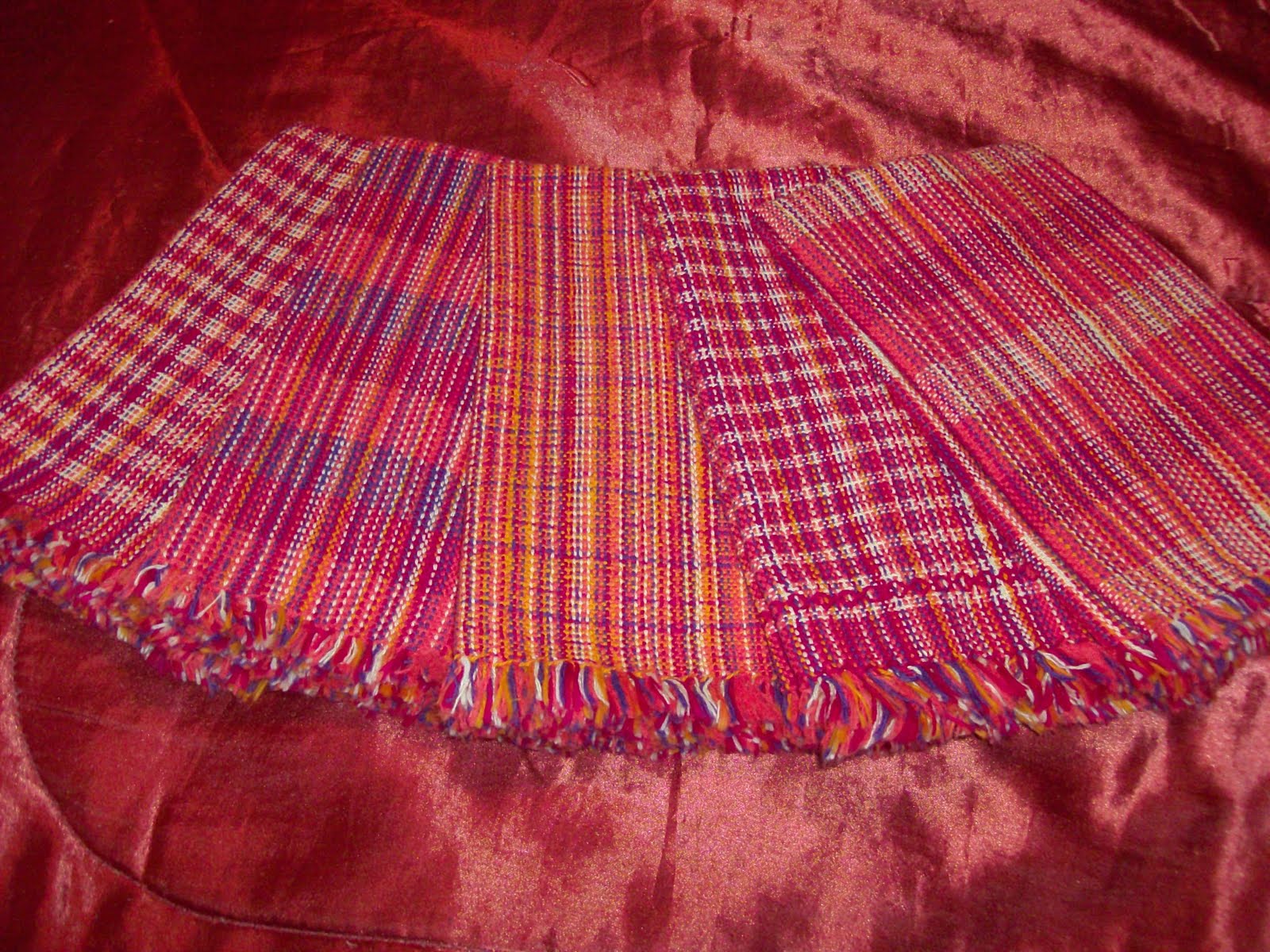
A couple bags of novelty yarns came my way recently, so I experimented making what I call "wild" shawls. I used two weights of rayon chenille on a blue shiney rayon warp sett at 10 epi. I interspersed the blue, light green and pink chenille with bands of the fluffy, multi-colored, novelty yarns for "wild" effects.

For one shawl, however, I used only the lighter weight chenille in deep teal, rust and rich purple, colors I observed in a crocheted shawl worn by a character in a Masterpiece Mystery Miss Marple episode. The colors are rich and very pleasing to me, conjuring up Medieval castles and aristocratic banquets, or by contrast, a colorful gypsy caravan.

Although Americans left the aristocracy behind in 1776, we are still fascinated by castles and knights and grand ladies in beautiful clothes.

And gypsies? Well, the mysterious world of living on the road, fortune telling, exotic music, women dancing in long skirts, colorful scarves, flashy jewelry, are always intriguing even for those of us who are more sedentary.

Sunday, December 12, 2010

Recycled Wool Rug


Now that my Christmas sale weaving projects are finished for the season, it's time to play at my looms.

Recently, friends brought me several bags of selvedge trimmings from the Pendleton Woolen Mill in Oregon. My friend was originally going to crochet circular rugs with the pieces, but decided against it, rather than discard them, she thought I might like to play with strips.

So, this weekend I warped up my loom with multi-colored cotton rug warp, enough for three 25-45 inch throw rugs. And here is the result of my project. The weaving went rather slowly since my LeClerc Nilus loom doesn't make a very deep shed (weaving may have gone more smoothly on my homemade counter balance loom with a deeper shed -- but it is occupied with another project) and the trimmings are quite bulky. My regular rag shuttle was too fat for the project, so I switched to a slimmer ski shuttle. I wove them in a simple plain weave and set the warp at 5 epi so the fluffy edges, similar to a wide, coarse chenille, would dominate.

I cut them off the loom and twisted and knotted the 6" fringes, then washed them with a bit of detergent on the gentle cycle in cold water and hung them to dry. The trimmings have been treated with a rather odorous moth resistant chemical which I wanted to wash away, or at least tone down.

If I weave others, I may set the warp at 10 and take more care in the warp color(s) to create a different effect. I think the pieces can also be woven into fabric for handbags.

Sunday, November 7, 2010

New Crazy Shawls


I just finished weaving three new shawls using thicker chenille yarns than I usually use and several novelty yarns. I started out wanting to weave something outrageous, but the original plan didn't work out. Am filing away that particular inspiration for a future project. It needs to gestate a while.

I don't have cable television, so until this week, I hadn't seen programs such as Project Runway. For fun, I rented Season 1 via Netflix. I thoroughly enjoyed watching the designers develop their concepts to meet the parameters of the various creative challenges. I was also thrown into a wave of nostalgia when I saw it was filmed at Parsons School of Design. Several of my NYC friends attended Parsons back in the 1960s when I lived there while I attended the Laboratory Institute of Fashion Merchandising -- all several lives ago.

Even through my life has taken me on many varied journeys from magazine publisher, journalist, farmer/rancher's wife, mother, English professor, I guess the fashion designing germ is still at work at a base level in my psyche worming its way out at my looms. I feel like I'm behind, however. The last 40 years haven't been wasted, but I've been distracted from some kinds of creative endeavors. Creativity builds upon itself, grows, so we'll see how far I can get on this particular resurrected life journey at my silly age . . .

Saturday, October 16, 2010

Scarves


The cooler weather of Fall/Autumn brings out my desire to spin wool and make warm clothing items, mainly handwoven scarves and crocheted handwarmers. This year, I am spinning both llama and wool fibers. Taking a pile of freshly sheared wool through washing, carding, spinning, plying, and weaving is a pleasurable, but time-consuming task. This year, however, I found a wonderful company near Salt Lake City, called Spinderella, whom I hired to wash and card a black sheep fleece and some llama fleeces that were given to me. Eliminating those two steps in the processing feels very luxurious. I can now merely enjoy my favorite parts of the process: spinning and weaving.

I plied two handspun strands of the llama yarn together (plying the opposite direction from which the strands are spun) to make a stronger yarn to withstand warp tension on my loom, and wove two scarves. One is woven in a loose, soft, twill weave; the other is softly woven plain weave. Both have overhand knotted fringe. $45 each.

Earlier, I also wove a batch of mixed fiber sparkle scarves in a variety of colors. They've been selling quickly. The only two I have left are gold and red. The red one looks rather pink in the computer's color translation, but is really quite red. $30 each.


Tuesday, September 14, 2010


I spent last weekend manning a booth at the Sagebrush Arts Fair in Pocatello, Idaho. I had a great time. I saw several people I hadn't seen in a long time and made some new friends. My tea towels sold well as did my scarves. I guess it was still too warm for people to show much interest in comfortable shawls. I'm posting a photo here for when my readers/customers decide a warm shawl on the shoulders on a cool autumn evening sounds nice. Shawls are $80-$90, depending on length.

Tuesday, August 31, 2010

Lots of Tea Towels


Every so often someone asks me "What's a tea towel?" My guess it's an old-fashioned term for dishtowel, a piece of cloth used to dry and polish one's china tea set or crystal glassware so the pieces don't develop water spots. Considering Pocatello's water, it's no easy feat to eliminate water spots on handwashed dishes.


As a weaver, there's something amazingly satisfying about weaving such humble, useful cloth. Even from the very beginning of my fascination with the craft back in the dark ages of the 1970s, I wasn't all that interested in weaving "wall hangings." I wanted to weave useful cloth, pieces I could wear that were entirely unique and household items for family and friends to respect and enjoy.


We treat cloth differently when we put the hours into making it ourselves, a significant lesson in this throw-away society we live in.


But I take pleasure in placing a colorful handwoven cloth over a bowl of rising bread dough. I enjoy lining a breadbasket with a handwoven cloth that coordinates with my dishes and table setting and placing it on my table for guests to enjoy. I occasionally wrap a loaf of freshly baked bread or fruitcake in a cloth and give it as a gift. Just having my cloth hanging on a rack in my kitchen gives me a large amount of visual pleasure.


There's been talk recently about the gulf between the person who works with his/her hands and those who prefer the intellectual life. I posit that it is silly to separate the two. Weaving has been a significant accompaniment to my intellectual development; it's the doorway to learning about the world via anthropology, economics, geography, philosophy, history, etc.


Making things from "scratch" teaches us almost all we need to know.

Saturday, July 10, 2010

New Projects


Much has happened since I last posted. My son, James, was married in a lovely ceremony in the Idaho mountains. At the bride's request, I wove a length of white chenille cloth my daughter, Patricia, made into a cloak for Michelle to wear in the cool evening during the reception. I'm hoping someone will soon give me a photo of it that I can post.


I also wove a length of cloth for Patricia to turn into a tailored jacket, an annual project we do together. She's an excellent seamstress, and we manage to sell these one-of-a-kind handwoven jackets before the next season. I'll post a photo of the cloth drying in my apple trees.


Yesterday, I took three scarves off one loom. Reds and purples and sparkles, loosely woven. I've developed a fondness for glitz. Does the sudden preference have anything to do with age? In my youth, my mother warned me against wearing anything that sparkled before the sun went down. Women who did were considered ... unspeakable ... pierced ears and dangling earrings fit in that category too. Thankfully, fashion these days has cast most of those taboos out the window. Even so, the shadow of that warning lingers in the background of many of my design decisions.


I have blue and white tea towels on one loom, and the other I am warping with black cotton on which to weave a series of cocoons since the first ones I wove turned out to be quite popular. These will be for evening wear, or special occasions. Soft and glitzy. I'm inspired by Art Deco clothing designs and color combinations. I hope they turn out as I'm imagining them.

Friday, May 28, 2010

Cocoons


I finally figured out how to weave and construct a cocoon, a very simple jacket/wrap made from two rectangles of handwoven cloth to be worn over a T-shirt, turtleneck, or simple dress. Without having an actual cocoon in hand, I relied on photos of the design that made it appear much more complicated than it is. Here are photos of my weaving experiments from this past week. These cocoons were woven on a mixed rayon/cotton warp. The wefts are cottons and synthetics from yarns I purchased in a "grab bag". I love the tweed-like effects. All three fabrics washed and dried beautifully. I added a few beads, either glass or wooden, on the cocoons' lapels for fun. Because they're experiments and the yarn was a bargain, I'm offering them for only $85 each.

Wednesday, May 19, 2010

Excitement


It's been an exciting week: my daughter Katie's book arrived in the mail (ALEUT IDENTITIES by Katherine Reedy-Maschner). The Preface is a fun read, has lots of our Croner family lore regarding her grandfather's (my father's) sailing escapades in Alaska and other Pacific Rim locations.


I also received a great picture book, photos of International/Historical textiles. The book documents beautiful blankets, clothing, headdresses, shoes, decorative tent bags from a variety of cultures around the world.


And second best to Katie's book, a huge box of yarn arrived, a grab bag of textures in reds, pinks and purples. I immediately measured a warp to weave a cocoon, a comfortable jacket/shawl fashioned from rectangles. I'll be putting the warp on the loom this afternoon, after visiting with a financial advisor to further see how this retirement business is going to work out.


My other loom is warped in 5 shades of green and I'm weaving another batch of tea towels/bread cloths. A cone of variegated, slub, cotton yarn arrived just in time for experimentation. The plethora of colors blend quite well over the random greens. I think I'll weave several of them as well as use the green yarns to create irregular plaid, Irish-green effects.


A recent NPR program discussed depression; a writer/guest described a peculiar ceremony he took part in in Kenya that was designed to cure depression. The ceremony required being stripped naked and being covered in mud; there was western music and African drumming, and eventually he was wrapped in the intestines of a sacrificial animal which he and the supportive crowd roasted and consumed together. And what amazed him is that he felt better when it was all over having been shaken from the trap in which he'd allowed his mind and western culture to envelop him.


Years ago, I read somewhere, one of those tidbits that lingers in the mind, that Jewish Rabbis are required to take up some kind of craft in which they must use their hands, things like woodworking, gardening, playing a musical instrument, etc., in order to keep them grounded in reality so that inquisitive minds don't run amok into the abstract. At least that's how I interpreted the demand. It makes sense to me. I find I'm most content when I'm involved in hands-on projects. There's much talk about eye/hand coordination, but there is also an important body/mind connection that much of our post-industrial lifestyle has erased. Perhaps too many things are done for us, and as a result, we fail to reap satisfaction from the simple tasks of yore like chopping wood, growing our own food, baking bread and even grinding our own grains. Spinning and weaving clothing and useful household textiles easily fits into this scenario.


As a child I read about Bedouin women spinning and weaving the tents they lived in, weaving the blankets they slept under, the rugs they slept on, the bags they stored their things in, making each item both for the sake of utility and beauty. Making things is a significant element of human nature; it's not by accident that engaging in crafts is relevant therapy in our culture's many mental health facilities . . .

Sunday, May 9, 2010

"Keep on keeping on"

Well, I guess it's official. I'm formally retired, the silver pen and pencil set has arrived from the university along with a certificate of appreciation. Kinda cheesy, but OK. It's kind of an odd retirement since I will return in the fall to teach part-time. With this quasi-forced arrangement, I gain lots of personal time, but lose my health insurance. There's no way I can continue to pay for it, and I don't qualify for Medicare for two more years.

Somehow this isn't how I envisioned retirement. First of all, I never expected to retire at all since I returned to the workforce so late in life. And secondly, "retirement" really means I slip back into pre-master's degree poverty, holding my heart in my mouth every time a bill arrives in the mail or I feel a twinge of pain. But I'm not surprised; I knew the bottom would fall out of things once I reached this age. I'm a baby-boomer of course, that generation that gets blamed for all the country's ills of the moment due to no fault of our own.

There are too many of us, babies born in celebration of the end of a devastating world war. Our numbers are sucking Social Security dry, and young people resent having to pay for our menial survival. However, few care to mention that we paid into the system too for this past half century and might deserve some of the benefits as well.

World cruises, sailboats, travel to exotic places, time on the beach won't be what my retirement is all about. I'll be lucky if I can maintain a roof over my head. These unexpected circumstances will certainly force me to keep busy, "busy" apparently being a respected American value since if you ask nearly anyone how they are, their response is "busy."

In the wake of my concern, my oldest daughter said, "You've always been very resourceful," and I guess she's right. I have been, and I'm quite proud of having fed and cared for my kids seeing them safely into adulthood. I'm proud of returning to the university later in live to complete my degrees, and I've enjoyed my years working as a newspaper reporter and college English instructor. I've worked hard and made use of the many disparate things I've learned along the way from farming/gardening/butchering chickens, to running a literary magazine, to writing/reporting, teaching, spinning wool, weaving, playing piano. Some activities that many would dismiss as mere hobbies, have turned into somewhat lucrative projects.

Generally, I enjoy my life. My children are close at hand. My grandsons are wonderful people

So, I guess I'll take songwriter Bob Dylan's words to heart and "keep on keeping on."

Sunday, May 2, 2010

Gypsy Caravan Bread Cloths


Crank up your favorite Gogol Bordello CD and cover your bowl of rising bread with one of these bread cloths; wrap a loaf in a cloth as a gift for a new neighbor.

I've always been fond of gypsy fashion and art. As a child in the western Washington woods of the 1950s, Gypsy was my Halloween costume choice. I loved colorful scarves, long skirts and dangling earrings -- still do. Recently a group of dear friends and I watched the 2009 film THE IMAGINARIUM OF DOCTOR PARNASSUS starring Christopher Plummer in which a traveling troupe of colorful magicians seek love and adventure and answers to the age-old riddles of life.

Costumes in the film are ethereal, glittery, bleeding color and sparkle. The film once again brought out my love for color, music, mysticism, fortune telling. . . I loved the film, even though it is not a box-office hit, but then I rarely agree with critics or the tastes of mass audiences.

Gypsies, Romani, have been either romanticized or vilified over the centuries. Hitler put them in death camps and eastern European governments forbade them their free, wandering lifestyle and forced them into mean camps/villages without decent means of support. According to recent news reports, they are still a controversial ethnic group in Europe and America.

Maybe I was a gypsy in a past life. Who knows?

Tuesday, April 20, 2010

Adaptation and Adjustment


I am good at adapting to my surroundings. In general, I believe this is a good thing, but there are times when adapting may not be to my benefit. For instance, my "new/used" LeClerc jackloom has developed a glitch in its ratchet system. Every so often, it releases and will not grab back. I examined the device, but haven't been able to understand what is making it misfire. So, I have adapted to the problem. When it occurs, I simply lean over and roll the back beam back until it's firm. This is not a comfortable action.


I've also become aware that when driving I adapt/adjust my speed to the car ahead of me even when the person is traveling several miles below the speed limit. It takes me a long time to realize I'm doing this and decide whether to pass, or merely wait until I get to my turn.


My youngest son is very aware of this trait in his mother. When he was helping me warp one time, he said, "Mom, if there was suddenly no electricity, I know you would figure out how to live without it." "Yes," I said. "While I," he said, "would figure out how to make my own."


Which attitude is the most creative? Both contribute to human survival. It's widely accepted that when change comes about in a human environment -- when people experience of lack of food, climate change, destruction of shelter, war -- humans either adapt, move on or die. But according to my son, changing the environment is also an option. Is this merely another form of adaption/adjustment? Or is it something more creative, actions that are made possible through education and a mechanical mindset and that elusive thing we call "hope".


Today I'm going to ask for help. I want to fix my loom so my weaving time will continue to be comfortable and prolific.

Friday, April 16, 2010

Festive Bread Cloths


Hot off the loom: Festive all cotton breadcloths/tea towels. I use them to wrap a loaf of freshly baked bread as a gift or to cover the bowl the bread rises in. They're also handy for drying crystal glassware. Some people use them under a centerpiece on a holiday table. They are completely machine washable and dryable. They've already been washed once to relax and soften the fibers.


I enjoy making these simple utilitarian household products. I believe that even a humble dishtowel can be special, a work of art. Every one of these towels is unique. I rarely, if ever, make any two items exactly alike. We live in a world of replication, of machine-made copies of copies from mountains identical paper forms to mounds of idential T-shirts. I take pleasure in knowing that I own handwoven fabrics exactly like no others in the entire world.


Stay tuned for my experiments in black.

Saturday, April 10, 2010


This is a photo of one of my favorite handwoven shawls. I no longer own it, but recently came across it draped over a chair at a friend's house. It felt good meeting up with an old friend, and I was glad the shawl had found an appreciative home.
And familiar textiles do indeed become friends; they enrich our lives in many ways. I'd bet most of us have a favorite towel, blanket, or wrap. Babies become attached to the comfort their "blankies" provide. When we come across a swatch of fabric from a forgotten dress or shirt, we are flooded with memories of ancient family picnics, days on the beach with beloved friends, berry picking in the Cascades, our grandmother's capable hands tying colorful apron strings as she prepares the Thanksgiving turkey for the last time. . .
Late last night I finished warping one of my looms with a gold rayon yarn that I will cover completely with intense, jewel-colored chenille yarns that arrived UPS this week: ruby, earthy sapphire, shale, emerald, amethyst. . .
These cones and others are sitting about my living room in groups. Before beginning a weaving project, I spend several days admiring yarns' colors and textures, moving the cones about to discover the most pleasing combinations. I'm often surprised at what "works" and what doesn't. Unlike a painter's palette, unless I dye my own yarns (which I do with my handspun wools), I must work with the colors as they come to me, and it should come as no surprise to other artists that I enjoy the creativity this limitation provides.
So, for the next couple of weeks, I will be weaving luxurious textiles, and I will become attached to each, and with luck, I'll find good homes for them.

Sunday, March 28, 2010

Swedish-Bordered Tea Towels


Today I finished weaving Swedish-inspired tea towels. These designs are clean and crisp and make me envision cosy kitchens, homemade whole-grain bread, open fires, live music and laughter.


The border pattern is derived from a simple 4-harness twill/diaper weave, colors, mostly blue, on a pure white background. I used 8/2 cotton sett at 20 ends per inch. I used an off-white (almost super-pale green) plain weave weft yarn with small soft slubs for absorbency.


I sell them for $13 apiece, or three for $35. They make great wedding gifts, or wrap a loaf of bread in one as a housewarming gift for a new neighbor.

Thursday, March 18, 2010

Spinning Yarns and Weaving Scarves


Last night I watched two of my grandsons while their parents attended a university function. The boys are 5 and 8. After playing a couple of games, eating oatmal cookies and apple slices, and noting there was nothing interesting on television, we settled down to tell stories.
I like to spin wool while spinning yarns.


The classic tales never seem to go out of style, especially those dealing with spinning wheels. I imagine myself an exceptional grandmother, a rare one who can tell the tales of Rumplestiltskin and Sleeping Beauty while actually spinning. The boys listened intently, marveling at the wheel's magic, and added their versions of the stories as the wheel turned and the yarn built up on the bobbin.


When I was a child I wanted to learn to spin so badly, but no one I knew had the slightest idea where to get a spinning wheel or how one worked. All our minds had been pretty much industrialized in the 1950s. Many of the home arts disappeared during that era as we became more and more factory dependent for our food and clothing. In those days, I turned my bicycle upside down and threw leaves on the spinning tires in hopes they would magically turn into gold, or thread, anything . . .


But along came the 1960s and 1970s. God Bless the Hippies and the Back to the Land Movement for reviving so many of the home arts.


Last week, I felt inspired by hints of spring, so I warped up one of my looms with a soft commercial wool and wove tweedy scarves with my handspun, two-ply yarn. (I know, sounds like something I should be inspired to do in the fall in anticipation of winter, but there's little control over inspiration.) One of these weft yarns is made by plying dark gray with light gray singles, the other is two-ply light grey wool. I spin by turning the wheel to the right. I ply singles together by turning the wheel to the left. Plying relaxes the fibers to create a softer yarn, and a stronger yarn as well, especially if it's to be used for warp. Plying also prevents the finished woven fabric from "tracking" or "curling" as well.


The scarves turned out rather well, I think. I gave one to a dear friend and have two more to sell. $30 each, a bargain considering the time involved in spinning, plying, warping, weaving . . . but when does a craftsperson get fully paid for his/her time? Rarely, it seems -- another sad byproduct of our overseas, factory-driven, cheap labor economy.

Tuesday, March 9, 2010

New projects and old


The responses I've received from the photo of my lovely daughter Katie petting the dead wolf have been odd. First of all, she didn't kill the wolf. It was shot by Alaskan natives. She's an anthropologist conducting an important subsistence survey. I don't know the context for the kill. It's easy to sit in a comfortable armchair and condemn faraway lifestyles few of us know anything about. Americans in general are spoiled by their luxuries and fall easily into the hands of weaselly marketing rhetoric.


Secondly, being able to touch such a creature and feel the texture of its fur is a rare privilege. I deal with fibers daily, animal and vegetable, and the variety of textures are amazing.


I included the photo because I thought it an interesting coincidence that a wolf photo would arrive in my mailbox the week I completed spinning and weaving a wolf/dog hair blanket for a client.


Let's not forget that the earliest clothing in northern climates that humankind donned were animal skins. Arctic natives still use these luxurious furs to keep warm. I guess in the tropics grass skirts would suffice.


We Americans/Europeans have grown used to wearing traditional cotton and linen fibers, then in the last century along came a rash of "man-made" fibers such as rayon (from a wood base), and polyester (from petroleum), but now producers are marketing new "alternative" fibers made from bamboo, seaweed, milk, soybeans, etc. The advertising jargon would lead us to believe these fibers are more environmentally sound because they're renewable (cotton was condemned recently because of the pesticides used in its production--hence the marketing of "organic" cotton), but the reality is that the chemistry used to turn these "new" fibers into yarn may be just as, or even more, damaging to the environment than fur or wool. In my mind, skinning or shearing an animal raised in the wild or in healthy conditions is more "natural" than soaking and retting fibers in harsh chemicals (which are dumped into sewers which eventually make their way into waterways). There is an environmental cost for everything we do.


I love spinning and weaving and use whatever fibers come my way that suit a project, man-made or "natural." My minute two-loom operation has little or no power in the massive fiber markets, and it appears from my observations this past half century that most of the "anti-this-and-that" rhetoric is really just another way to turn our heads from one marketing ploy to another. And, after all, once any fiber has been turned into roving or yarn, it would be wasteful not to use it.

Thursday, March 4, 2010

Katie and the Wolf


Here's a photo of my amazing anthropologist daughter, Katie petting a freshly killed wolf near Falls Pass, Alaska, this week.

Sunday, February 28, 2010

Wolf Laid to Rest


Here's a photo of the finished handspun/handwoven wolf/dog hair project with handspun llama wool borders.


I hope the animal owners like it.

Howling at the Moon


I am 95% finished with a project that is unusual for me. A client brought over a large bag of wolf/dog hair they wanted spun and woven into a blanket. It took several weekends of spinning and plying to turn the fluffy hair into yarn. As a result, I will be finding fine, white, floating dog hairs throughout my house and on my clothing for months, I'm sure.

This weekend I completed the weaving on my LeClerc 4-harness jackloom, and the blanket has been hand-washed and is hanging up to dry. The two-ply yarn was fairly thick, so I sett the warp at 4 epi in an 8-dent reed. During the weaving, I experienced a few popped warp threads since some of the yarn was rather soft-spun and slubby (I like to say "interestingly textured") which will require some reweaving as I go over the finished product when it's dry.

Because the project is a simple plain weave and off-white/natural, I decided to add a bit of interest with a couple of brown/black stripes at either end of the blanket -- some handspun llama wool I happen to have on hand.

I'm including a couple of photos I took during the weaving process. I will post a finished photo shortly.